
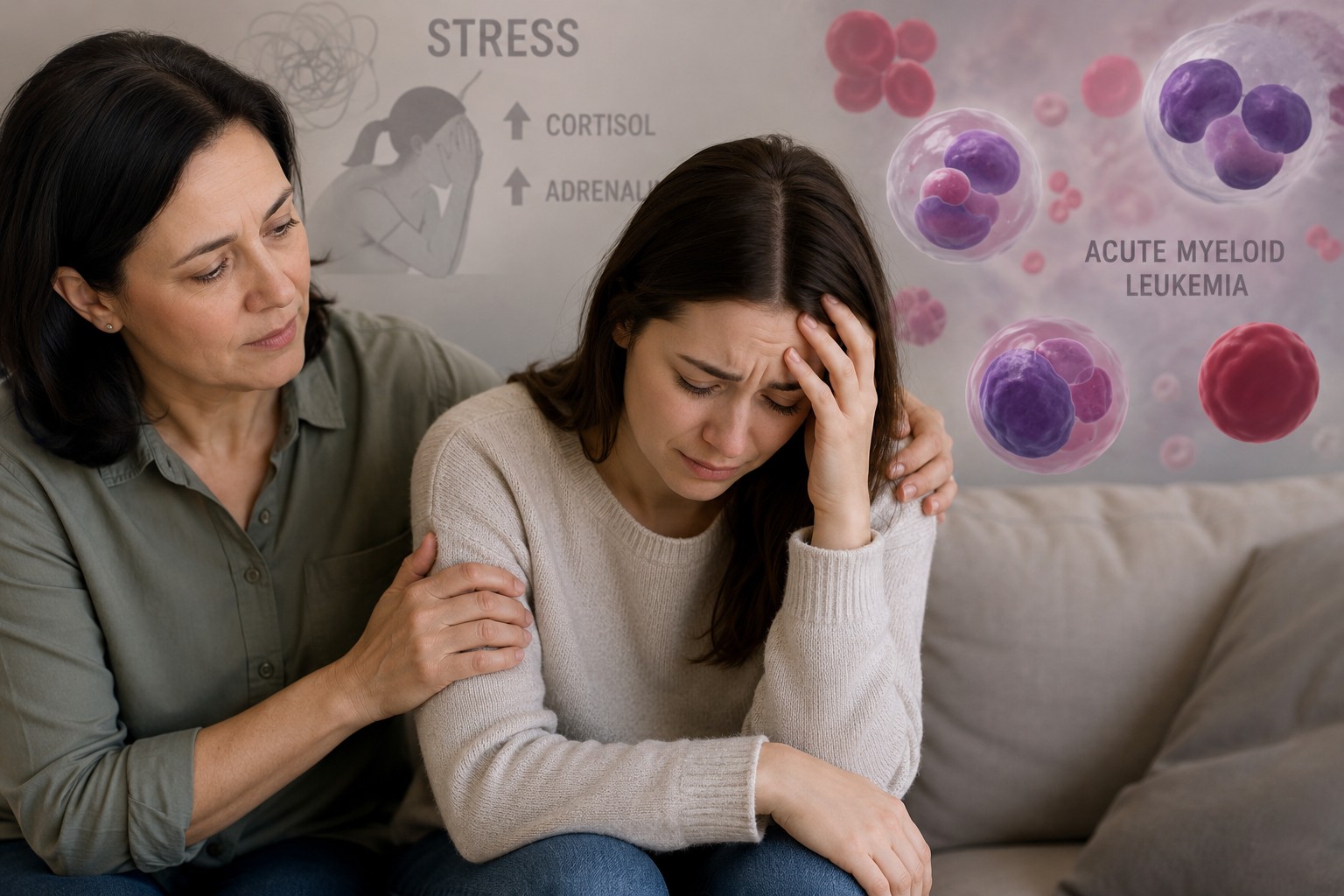
Can you "get sick from nerves"?
When someone learns of a serious diagnosis like acute myeloid leukemia (AML), it's natural to look for a cause. Often both patients and relatives recall a period of severe stress — the loss of a loved one, a divorce, a difficult time at work — and think: "It must have been the stress." This is an understandable and very human reaction. But it's important to understand what science actually tells us.
What stress is
Stress is the body's natural response to difficulties and overload. During stress, hormones such as cortisol and adrenaline are released, temporarily affecting the heart, blood pressure, sleep, appetite, and the immune system. Chronic stress is genuinely harmful to health: it is linked to high blood pressure, heart problems, anxiety, and depression.
Can stress cause AML?
AML develops because of damage (mutations) in the genes of bone marrow cells responsible for producing blood. The cell begins to divide uncontrollably. In theory, it was suggested that stress hormones might affect the immune system's surveillance of abnormal cells. However:
- There is no scientific evidence that psychological stress causes AML. Stress does not damage the genes of bone marrow cells the way radiation or chemicals do.
- Research into the causes of leukemia examines radiation, chemicals, smoking, and heredity — and that is where clear links have been found. Stress is not on the list of proven causes.
Put simply: stress is hard on the body, but it is not a cause of acute myeloid leukemia. Your illness is not your fault, and it is not the fault of the hardships you have lived through.
What actually raises the risk of AML (proven factors)
These are factors backed by real scientific evidence. Importantly: having a risk factor does not mean the disease will necessarily develop — most people with these factors never develop AML.
- Ionizing radiation — high doses of radiation. The strongest evidence comes from studies of survivors of the atomic bombings in Japan.
- Benzene and certain workplace chemicals — prolonged occupational exposure. Benzene is officially recognized as a cause of AML.
- Previous cancer treatment — some types of chemotherapy and radiation therapy (given for another tumor) can raise the risk of so-called secondary leukemia years later.
- Tobacco smoking — the link is established, and the risk is higher the longer and heavier the smoking history.
- Inherited features — rare congenital genetic syndromes and familial mutations. Uncommon, but real.
- Age — AML develops more often in older people.
The key thing to remember
Stress worsens how you feel, but it does not cause leukemia. The proven causes are radiation, certain chemicals, smoking, previous cancer treatment, and rare inherited features. If feelings of guilt or anxiety about your illness trouble you, that is normal — and it is worth talking about with your treating doctor or a psychologist.
Short links to sources (for specialists / curious readers):
- Radiation: study of atomic bomb survivors — doi.org/10.1667/RR1801.1
- Benzene: meta-analysis of occupational exposure — doi.org/10.1289/EHP15086
- Smoking: dose-dependence meta-analysis — doi.org/10.1016/j.critrevonc.2016.01.003
- Heredity: review of germline predisposition — doi.org/10.1146/annurev-pathmechdis-111523-023420
This note is informational and does not replace a consultation with a doctor. Sources are from the PubMed database.