
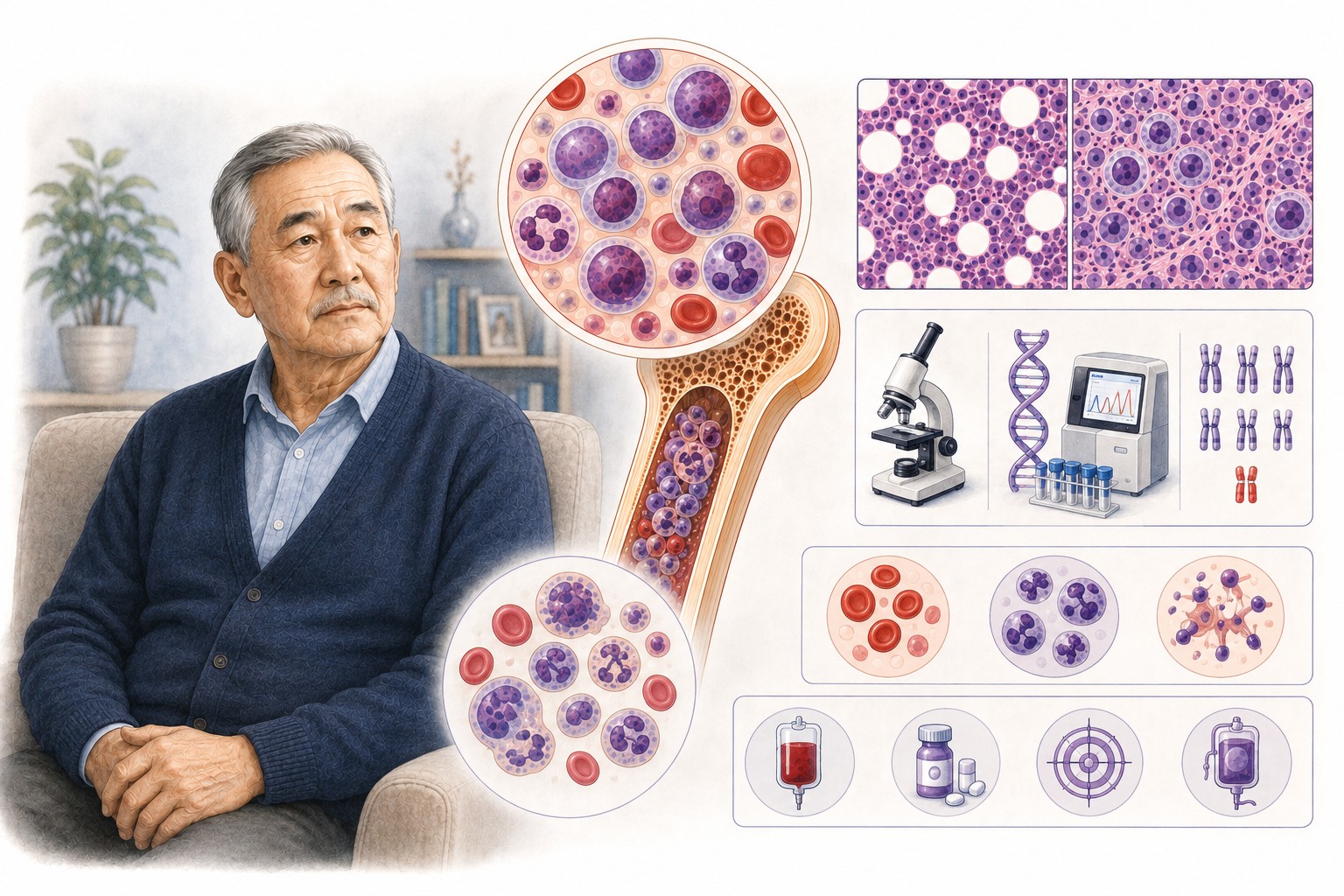
Myelodysplastic Syndromes (MDS): Key Information for Patients
Based on NCCN Guidelines for Patients® — Myelodysplastic Syndromes, 2026 (NCCN Clinical Practice Guidelines in Oncology, Version 3.2026 — January 12, 2026)
What Is MDS
Myelodysplastic syndromes (MDS) are a group of uncommon blood cancers in which the bone marrow stops making enough healthy, mature blood cells. In MDS, the immature blood cells (blasts) in the bone marrow do not develop correctly, resulting in low counts of one or more types of blood cells — a condition called cytopenia.
The three main types of cytopenia in MDS:
- Anemia: low red blood cells → fatigue, shortness of breath, pale skin
- Neutropenia: low neutrophils (a type of white blood cell) → frequent infections and fevers
- Thrombocytopenia: low platelets → easy bruising and bleeding
Important: MDS can progress to acute myeloid leukemia (AML) in about 1 in 3 patients. Monitoring for this transformation is a key goal of ongoing care.
Most people with MDS will need blood or platelet transfusions at some point to manage low blood counts.
Types of MDS (WHO 2022 Classification)
| Type | Key feature |
|---|---|
| MDS with low blasts (MDS-LB) | Few immature cells; less aggressive |
| MDS with 5q deletion (MDS-5q) | Loss of part of chromosome 5; usually responds well to lenalidomide |
| MDS with SF3B1 mutation (MDS-SF3B1) | Specific gene mutation; ring sideroblasts present; responds to luspatercept |
| MDS, hypoplastic (MDS-h) | Fewer cells than normal in bone marrow |
| MDS with biallelic TP53 inactivation (MDS-biTP53) | Inactivated TP53 protein; aggressive, poor prognosis |
| MDS with increased blasts (MDS-IB) | More blasts (MDS-IB1 or MDS-IB2); higher risk of AML transformation |
| MDS with fibrosis (MDS-f) | Scarring (fibrosis) in bone marrow |
Risk Groups
Treatment strategy is determined by the Revised International Prognostic Scoring System (IPSS-R), which classifies MDS into five groups based on blast percentage, severity of cytopenias, and chromosomal changes:
| IPSS-R group | NCCN category |
|---|---|
| Very low risk | Lower risk |
| Low risk | Lower risk |
| Intermediate risk | Lower risk or Higher risk (borderline) |
| High risk | Higher risk |
| Very high risk | Higher risk |
A more precise tool — IPSS-M (adds specific gene mutations to IPSS-R) — may also be used for prognosis.
Diagnostic Workup
Required tests:
- Medical history and physical exam (including family history; genetic testing for inherited disorders if under age 50)
- CBC with differential, platelet count, reticulocyte count
- Blood smear examination
- Serum erythropoietin (EPO) level — measured before any red blood cell transfusion
- Vitamin B12 and folate; serum ferritin, iron, TIBC
- TSH (thyroid-stimulating hormone)
- LDH
- Bone marrow aspiration and biopsy — essential for diagnosis and MDS typing
- Genetic/cytogenetic testing: karyotype, FISH, PCR, NGS — to identify chromosomal abnormalities (especially del(5q), del(7), monosomy 7, +8, del(20q)) and gene mutations (SF3B1, TP53, IDH1, IDH2, and others)
Tests in certain cases: HIV testing; copper deficiency evaluation; flow cytometry; HLA typing (if transplant planned)
Why genetics matter: MDS treatment is tailored to the specific genetic and chromosomal profile of the disease. The same treatment may not work for different types of MDS.
Treatment Overview
Treatment is divided into two main pathways based on risk:
| Lower-risk MDS | Higher-risk MDS |
|---|---|
| Goal: manage symptoms — improve blood counts, reduce transfusion needs | Goal: modify the cancer — slow growth, prevent AML transformation |
| Less intensive therapies | More intensive therapies, possibly transplant |
Drugs Used in MDS
Hypomethylating agents (HMAs) — the backbone of MDS treatment:
- Azacitidine (Vidaza) — subcutaneous or IV
- Decitabine — IV infusion
- Decitabine + cedazuridine (Inqovi) — oral tablets
Targeted therapies:
- Imetelstat (Rytelo) — telomerase inhibitor; IV; for lower-risk MDS with anemia
- Ivosidenib (Tibsovo) — IDH1 inhibitor; oral; for MDS with IDH1 mutation
- Enasidenib (Idhifa) — IDH2 inhibitor; oral; for MDS with IDH2 mutation
- Venetoclax (Venclexta) — BCL-2 inhibitor; oral; used with HMA in higher-risk MDS
Erythropoiesis-stimulating agents (ESAs):
- Epoetin alfa (Epogen/Procrit) and Darbepoetin alfa (Aranesp) — subcutaneous injections; stimulate red blood cell production in lower-risk MDS with anemia
Erythroid maturation agent:
- Luspatercept-aamt (Reblozyl) — subcutaneous injection; for lower-risk MDS with anemia (especially SF3B1-mutated)
Immunomodulatory drug:
- Lenalidomide (Revlimid) — oral capsule; for lower-risk MDS with del(5q)
Immunosuppressive therapy (IST):
- Anti-thymocyte globulin (ATG/Atgam) + Cyclosporine A ± Eltrombopag — for selected lower-risk MDS patients (hypoplastic MDS, young patients)
Growth factors:
- Granulocyte colony-stimulating factor (G-CSF/Filgrastim) — increases white blood cells; may be combined with ESAs
Thrombopoietin receptor agonists:
- Eltrombopag (Promacta) — oral; used with IST; for MDS with low platelets
- Romiplostim (Nplate) — subcutaneous; for MDS with low platelets
Treating Lower-Risk MDS
If asymptomatic (no symptoms): active monitoring ("watch and wait") with regular blood count checks.
If significant thrombocytopenia or neutropenia: HMA (azacitidine, decitabine, or decitabine+cedazuridine) or IST ± eltrombopag → if no response: add IDH1/IDH2 inhibitor or consider allogeneic HCT.
If symptomatic anemia — treatment depends on MDS subtype and EPO level:
With del(5q) (MDS-5q):
- EPO ≤500 mU/mL: Lenalidomide (preferred) or ESA (epoetin alfa/darbepoetin alfa)
- EPO >500 mU/mL: Lenalidomide (preferred)
- If no response or relapse → IST if appropriate → then imetelstat (preferred), HMA, or allogeneic HCT for eligible patients; IDH1/IDH2 inhibitors if mutations present
With SF3B1 mutation (MDS-SF3B1):
- Luspatercept (preferred)
- Imetelstat (other recommended, for EPO >500 mU/mL if ESA not possible)
- If no response: ESAs ± G-CSF, imetelstat if not given, HMA, IDH1/IDH2 inhibitors
Without del(5q), with or without other cytogenetics:
- EPO ≤500 mU/mL: Epoetin alfa or darbepoetin alfa; luspatercept preferred if EPO >200 mU/mL
- EPO >500 mU/mL: imetelstat, luspatercept, ESA ± G-CSF or lenalidomide
- If no response → same additional options as above
Treating Higher-Risk MDS
Treatment depends on whether allogeneic HCT is planned.
If allogeneic HCT is planned or possible:
- First: allogeneic HCT directly, OR clinical trial → HCT, OR HMA ± venetoclax, OR high-intensity chemotherapy as bridge to HCT
- If no transplant yet: IDH1/IDH2 inhibitors if mutations present
- Post-transplant relapse: second transplant or donor lymphocyte infusion; HMA; clinical trial
If allogeneic HCT is NOT planned:
- Preferred: azacitidine, decitabine, or decitabine+cedazuridine
- Other options: clinical trial; HMA + venetoclax (in certain cases)
- If no response or relapse: IDH1/IDH2 inhibitors if mutations present; HMA + venetoclax if not yet given; clinical trial
Allogeneic Hematopoietic Cell Transplant (Allo-HCT)
The only potentially curative treatment for MDS. Uses healthy donor stem cells to replace the diseased bone marrow. Requires HLA typing to find a matched donor. Intensive and not suitable for all patients — depends on age, health, and performance status.
Steps: conditioning chemotherapy ± radiation → donor stem cell infusion → engraftment (2–4 weeks) → new, healthy bone marrow forms.
Side effects include infections (due to immune suppression), bleeding, and graft-versus-host disease (GVHD) — where donor cells attack the patient's body.
MDS/MPN Overlap Syndromes
Some cancers share features of both MDS and MPN. Types include:
- CMML (chronic myelomonocytic leukemia) — too many monocytes; CMML-1 (fewer blasts): hydroxyurea or HMA; CMML-2 (more blasts): HMA ± venetoclax and/or allo-HCT
- MDS/MPN with neutrophilia — HMA and/or ruxolitinib and/or allo-HCT
- MDS/MPN with SF3B1 mutation and thrombocytosis — HMA and/or lenalidomide or luspatercept
- MDS/MPN, not otherwise specified (NOS) — HMA and/or allo-HCT
Supportive Care
Transfusions: red blood cell transfusions for symptomatic anemia; platelet transfusions for significant thrombocytopenia with bleeding.
Iron overload: repeated transfusions (≥20) can cause iron accumulation in organs. Iron chelation therapy (deferoxamine or deferasirox) is used to treat iron overload.
For thrombocytopenia: thrombopoietin receptor agonists; antifibrinolytic agents (aminocaproic acid) if bleeding persists.
Infection prevention: antibiotics for bacterial infections; antimicrobial prophylaxis after transplant.
Psychosocial support: counseling, education, support groups; quality-of-life assessment.
Key Messages for Patients
- MDS is not one disease — it is a group of conditions with very different prognoses and treatment needs. Knowing your MDS type and risk group is essential for receiving the right treatment.
- The IPSS-R risk classification directly determines your treatment path. Ask your care team which group you are in and what it means for your prognosis.
- Genetic testing is not optional — it is the foundation of MDS treatment decisions. The presence of del(5q), SF3B1, IDH1, IDH2, or TP53 mutations each opens or closes specific treatment options.
- Lower-risk, asymptomatic MDS may not need treatment immediately. Active monitoring is a valid and evidence-based approach.
- Serum EPO level determines which anemia treatment to start with. Know your EPO level and how it influences your options.
- If you are younger and have higher-risk MDS, discuss allogeneic HCT early — it is the only curative option and requires time to find a donor.
- Iron overload from transfusions is a real concern — ask your care team to monitor ferritin levels and consider chelation if needed.
- Clinical trials are actively ongoing for MDS and are strongly encouraged at every stage.
- Seek care at or consultation with an MDS specialist — this rare disease benefits greatly from expert input.
Source: NCCN Guidelines for Patients® — Myelodysplastic Syndromes, 2026 (based on NCCN Clinical Practice Guidelines in Oncology, Version 3.2026 — January 12, 2026). National Comprehensive Cancer Network® (NCCN®).
Full original document available free of charge: NCCN.org/patientguidelines
This material is for informational purposes only and does not replace consultation with a treating physician.
Download PDF
pa_b9b8b5d3-1800-42d1-b2ed-2aebff478f76_1778342689321.pdf