
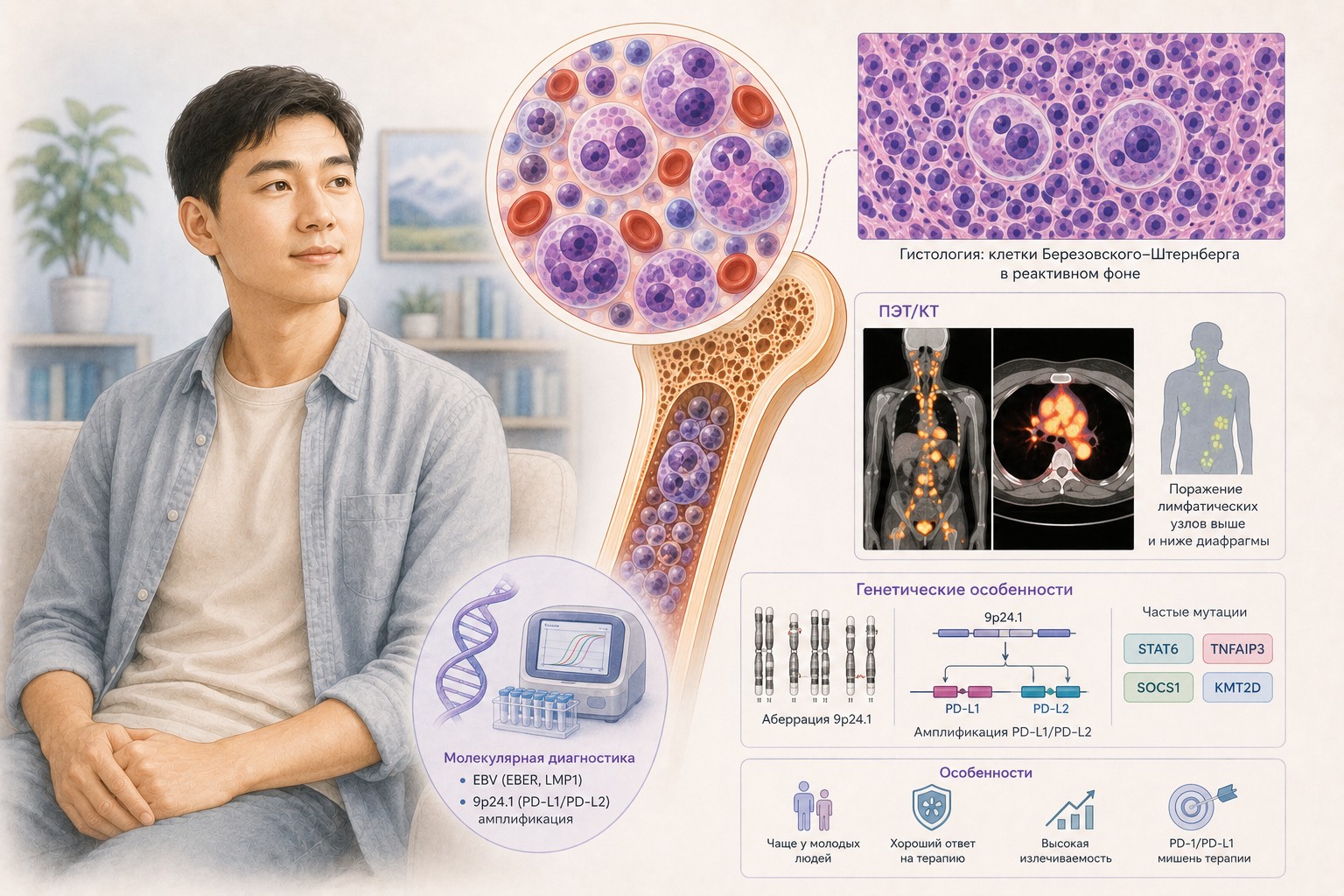
Hodgkin Lymphoma in Adults: Key Information for Patients
Based on NCCN Guidelines for Patients® — Hodgkin Lymphoma in Adults, 2025 (NCCN Clinical Practice Guidelines in Oncology, Hodgkin Lymphoma Version 2.2025 — January 30, 2025)
What Is Hodgkin Lymphoma
Hodgkin lymphoma (HL) is a highly curable cancer that begins in lymphocytes — white blood cells that protect the body from infection. It most commonly starts in lymph nodes in the upper body (neck, chest, armpits). Most patients are diagnosed between the ages of 15–30 or after age 55.
Hodgkin lymphoma is distinguished from other lymphomas by a characteristic cell type: Reed-Sternberg cells — abnormally large lymphocytes that often have more than one nucleus, visible under a microscope.
There are two types:
- Classic Hodgkin lymphoma (CHL) — defined by Reed-Sternberg cells; the vast majority of cases
- Nodular lymphocyte-predominant Hodgkin lymphoma (NLPHL) — a rare, usually slow-growing subtype defined by "popcorn-shaped" cells; can occasionally transform into diffuse large B-cell lymphoma (DLBCL)
Symptoms
B symptoms (report these to your provider):
- Unexplained fever (above 38°C / 100.4°F)
- Drenching night sweats
- Unexplained weight loss
Other possible symptoms:
- Itchy skin (pruritus)
- Extreme fatigue despite sleep
- Pain reaction to alcohol (pain at lymph node sites after drinking)
- Painless swollen lymph nodes — neck, armpits, groin
Diagnostic Workup
Essential tests:
- Excisional lymph node biopsy (preferred; whole lymph node removed) — the only definitive way to diagnose HL. Core needle biopsy if excisional is not possible. Fine-needle aspiration (FNA) is NOT recommended for diagnosing HL.
- Immunohistochemistry (IHC): CHL typically shows CD15+ and CD30+ but CD3− and CD45−
- CBC with differential; ESR; comprehensive metabolic panel; liver function tests; LDH; HIV testing
- FDG-PET/CT scan from skull to thighs — gold standard for staging and treatment response
- Hepatitis B/C testing (encouraged)
- Pregnancy test before chemotherapy or radiation if applicable
Tests when indicated:
- Lung function tests — if ABVD is planned (bleomycin can damage lungs)
- Echocardiogram or MUGA scan — if anthracycline (doxorubicin) is planned (± atorvastatin)
- Bone marrow biopsy — generally not needed for initial staging if PET/CT does not suggest marrow involvement
- Fertility preservation consultation before potentially fertility-impairing therapy
Deauville 5-point scale: used throughout treatment to interpret PET/CT. Score 1–3 = no concerning disease. Score 4–5 = concerning disease requiring biopsy or treatment escalation.
Staging
| Stage | Description |
|---|---|
| 1 | Cancer in 1 lymph node group (± 1 extralymphatic site) |
| 2 | Cancer in ≥2 lymph node groups on the same side of the diaphragm |
| 3 | Cancer above and below the diaphragm (± spleen or 1 extralymphatic site) |
| 4 | Cancer spread to multiple areas outside the lymphatic system |
A = no B symptoms; B = B symptoms present. Stages 1–2 = early CHL. Stages 3–4 = advanced CHL.
Treatment: Classic Hodgkin Lymphoma (CHL)
Early CHL (Stages 1–2): Favorable vs Unfavorable
Unfavorable features (any one present = unfavorable):
- B symptoms
- Bulky tumor ≥10 cm
- Elevated ESR
- Cancer in more than 2 lymph node areas
- Extranodal involvement (e.g., lung)
Favorable stage 1–2: 2 cycles ABVD → PET/CT:
- Deauville 1–3 → ISRT or 2 more ABVD (choice based on cancer features)
- Deauville 4 → 2 more ABVD, then re-PET; Deauville 1–3 → ISRT; Deauville 4–5 → biopsy
- Deauville 5 → biopsy; if positive → treat as refractory
Unfavorable stage 1–2 — 4 pathways, all include ISRT:
| Pathway | Primary treatment | If Deauville 1–3 | If Deauville 4–5 |
|---|---|---|---|
| ABVD | 2 cycles ABVD → PET | 4 cycles AVD or 2 ABVD + ISRT | 2 ABVD or BrECADD+G-CSF, then ISRT |
| Immunotherapy | 4 cycles nivolumab+AVD + ISRT | Follow-up | Biopsy |
| BV-AVD | 4 cycles BV-AVD+G-CSF + ISRT | Follow-up | Biopsy |
| BrECADD | 2 cycles BrECADD+G-CSF → PET; 2 more → ISRT | Follow-up | Biopsy |
Advanced CHL (Stages 3–4)
International Prognostic Score (IPS) factors: age ≥45, male sex, stage 4, albumin <4 g/dL, anemia, leukocytosis, lymphocytopenia.
Preferred regimens:
- Nivolumab + AVD × 6 cycles: Deauville 1–3 → done; Deauville 4–5 → biopsy
- BrECADD + G-CSF: 2 cycles → PET; Deauville 1–3 → 2 more BrECADD → done; Deauville 4–5 → biopsy
Other regimens (when preferred not available):
- BV-AVD + G-CSF × 6: Deauville 1–3 → follow-up; ± ISRT for high-risk areas
- ABVD × 2 → PET: Deauville 1–3 → 4 cycles AVD ± ISRT; Deauville 4–5 → switch to BrECADD
CHL During Pregnancy
Most common blood cancer in pregnancy. Multidisciplinary management required (oncology + high-risk obstetrics + neonatology).
Avoid: FDG-PET/CT, CT, BV-AVD, escalated BEACOPP, radiation therapy.
First trimester: delay if possible; vinblastine alone if urgent; ABVD after first trimester.
Second/third trimester: ABVD is safe for mother and baby.
Breastfeeding: avoid while receiving chemotherapy.
CHL in Older Adults (>60 years)
Clinical trial strongly recommended. Bleomycin should not exceed 2 cycles in older adults.
If doxorubicin is tolerable:
- Stage 3–4: nivolumab+AVD × 6 (preferred); or BV × 2 → AVD × 6 → ±BV × 2
- Early stages: A(B)VD ± ISRT; BV-based or nivolumab-based options
If doxorubicin cannot be given: BV + dacarbazine or BV + nivolumab; or nivolumab/pembrolizumab.
Refractory or Relapsed CHL
Biopsy always required before initiating treatment. Treatment depends on candidacy for HDT/ASCR (autologous stem cell transplant).
HCT Candidates
Primary refractory or relapse <3 months:
- Second-line therapy (with checkpoint inhibitor preferred):
- BV + nivolumab; GVD + pembrolizumab; ICE + nivolumab; ICE + pembrolizumab
- Without checkpoint inhibitor: BV; BV + bendamustine; DHAP; GVD+ICE; IGEV; ICE+BV
- Restage → Deauville 1–3: autologous HCT ± BV maintenance; Deauville 4–5: additional options
Late relapse (>3 months): second-line therapy → HCT; treatment individualized.
Non-HCT Candidates
Checkpoint inhibitor (nivolumab or pembrolizumab) OR brentuximab vedotin — based on treatment history.
Treatment: NLPHL
Rituximab (anti-CD20) is central to NLPHL treatment.
| Stage | Treatment |
|---|---|
| Non-bulky 1A–2A | ISRT alone (or observation if single node fully removed) |
| Bulky 1A–2A; stages 1B–2B | Chemo+rituximab (ABVD-R, CHOP-R, or CVbP-R) + ISRT |
| Non-contiguous 2A | Chemo+rituximab ± ISRT; rituximab alone for symptom relief |
| Stages 3–4 | Observation if asymptomatic; OR rituximab alone; OR chemo+rituximab ± ISRT |
Relapsed/refractory NLPHL: biopsy to rule out DLBCL transformation. If not transformed and asymptomatic non-bulky → observe or rituximab ± ISRT. Second-line: rituximab ± bendamustine/DHAP/ICE/IGEV.
After Treatment: Survivorship and Late Effects
First 5 Years (Monitoring for Relapse)
- Physical exam every 3–6 months (years 1–2); every 6–12 months (year 3); yearly after
- CT scan only if relapse clinically suspected — not routine
- PET/CT only if prior response was unclear — not scheduled routinely
- TSH annually if neck/upper chest was irradiated
Long-Term Late Effects (After 5 Years)
Heart disease: from mediastinal radiation and/or doxorubicin; appears >5–10 years after treatment. Annual blood pressure; lipids twice yearly; fasting glucose annually; echocardiogram and exercise stress test every 10 years.
Hypothyroidism: ~50% of patients who received neck radiation. TSH annually. Symptoms: weight gain, dry skin, cold intolerance, constipation.
Secondary cancers: mainly lung, breast, and skin cancers in irradiated areas; appear >10 years post-treatment.
Breast cancer screening (female, intact breast tissue):
- If chest/axillary radiation: mammogram starting 8 years after treatment or at age 40 (whichever first)
- If radiation between ages 10–30: add annual breast MRI
- Clinical breast exam 1–2×/year
Other screening: cervical, colorectal, endometrial, lung, prostate cancers per NCCN/ACS guidelines.
Key Messages for Patients
- Hodgkin lymphoma is one of the most curable cancers — even at advanced stages, the majority achieve long-term remission.
- PET/CT with Deauville scoring drives every major treatment decision. Understanding your score at each restaging is essential.
- PET-adapted therapy allows reducing toxicity in responding patients and escalating in non-responders.
- Bleomycin (the "B" in ABVD) carries lung toxicity risk — lung function must be tested before treatment; it may be dropped if problems arise.
- Doxorubicin (the "A" in ABVD) carries cardiac risk — baseline echocardiogram is mandatory.
- Treatment late effects (second cancers, heart disease, hypothyroidism) can appear decades later — long-term follow-up and cancer screening are essential.
- Fertility preservation should be discussed before starting chemotherapy if future childbearing is a consideration.
- For relapsed/refractory CHL, autologous HCT remains standard; checkpoint inhibitor-containing salvage regimens are now preferred.
- Clinical trials recommended at all stages, especially for older adults and relapsed disease.
Source: NCCN Guidelines for Patients® — Hodgkin Lymphoma in Adults, 2025 (based on NCCN Clinical Practice Guidelines in Oncology, Version 2.2025 — January 30, 2025). National Comprehensive Cancer Network® (NCCN®).
Full original document free at: NCCN.org/patientguidelines
This material is for informational purposes only and does not replace consultation with a treating physician.
Download PDF
pa_8cfcd3ff-00ba-4eec-bdb2-3b4c451fab92_1778341041186.pdf