
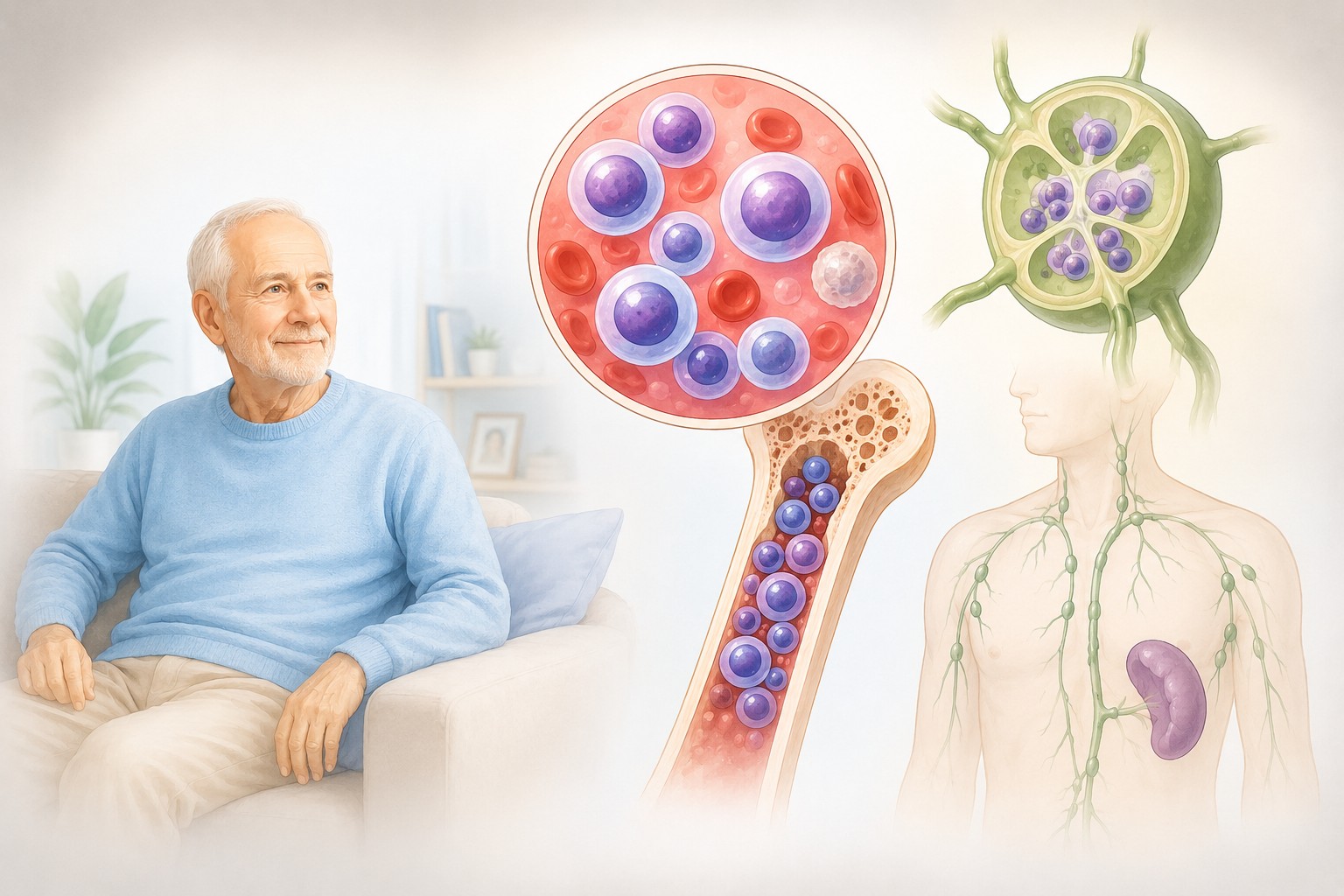
Chronic Lymphocytic Leukemia (CLL): Key Information for Patients
Based on NCCN Guidelines for Patients® — Chronic Lymphocytic Leukemia, 2026 (NCCN Clinical Practice Guidelines in Oncology, Version 1.2026 — October 10, 2025)
What Is CLL
Chronic lymphocytic leukemia (CLL) is a blood cancer that affects B lymphocytes — a type of white blood cell. In CLL, abnormal B cells multiply uncontrollably, crowding out healthy blood cells and impairing the immune system's ability to fight infections.
CLL is typically a slow-growing (indolent) cancer. Many people live with CLL for years without needing treatment. Some may never require treatment at all.
CLL and SLL are the same cancer. The difference is location: CLL cells are found mainly in the blood and bone marrow; small lymphocytic lymphoma (SLL) cells are found mainly in the lymph nodes. Treatment is identical for both. An exception is stage 1 SLL, where radiation therapy alone may be curative.
There is currently no cure for CLL, but treatments can control the disease for many years and significantly extend life.
Symptoms
Many people have no symptoms when CLL is first detected. When symptoms occur, they may include:
- Enlarged lymph nodes (neck, armpits, groin)
- Enlarged spleen or liver (causing abdominal fullness or discomfort)
- Fatigue and weakness
- B symptoms: fever without infection, drenching night sweats, unexplained significant weight loss
- Frequent or severe infections
- Easy bruising or bleeding (from low platelet count)
- Shortness of breath or pallor (from anemia)
Diagnostic Workup
Confirming the diagnosis. CLL is diagnosed by blood tests showing ≥5,000 monoclonal B lymphocytes per microliter. Immunophenotyping by flow cytometry confirms the CLL cell pattern. Lymph node biopsy confirms SLL. Bone marrow biopsy is done only in specific situations.
Tests to plan treatment (performed before starting any line of therapy):
- Complete blood count (CBC) with differential
- Comprehensive metabolic panel
- FISH testing for chromosomal abnormalities: del(17p), del(11q), del(13q), trisomy 12
- DNA sequencing for TP53 mutation and IGHV mutation status (IGHV is tested once — it does not change over time)
- Karyotype (complex karyotype = ≥3 unrelated changes, indicates higher risk)
- Beta-2 microglobulin level (elevated = more aggressive disease)
Additional tests when needed:
- Quantitative immunoglobulins, SPEP/SIFE
- Reticulocyte count, haptoglobin, direct antiglobulin test (DAT) — to evaluate for autoimmune hemolytic anemia
- LDH, uric acid
- CT of chest/abdomen/pelvis with contrast
- Hepatitis B and C testing before treatment
- Whole-body FDG-PET/CT — if Richter's transformation is suspected
Why biomarker testing matters: del(17p) and TP53 mutation indicate high-risk disease that does not respond to standard chemoimmunotherapy and requires targeted therapy regardless of disease stage. IGHV-unmutated status is associated with a more aggressive course.
Staging
The Rai staging system (stages 0–4) is used for CLL:
- Stage 0 (low risk): elevated lymphocyte count only
- Stages 1–2 (intermediate risk): + enlarged lymph nodes ± enlarged spleen/liver
- Stages 3–4 (high risk): + anemia (stage 3) or thrombocytopenia (stage 4)
The Lugano system is used for SLL (limited: stages 1–2; advanced: stages 3–4).
Stage does not by itself determine when to start treatment.
When to Start Treatment: Watch and Wait
CLL usually grows slowly, and starting treatment early has not been shown to improve survival. A period of active monitoring without treatment — called watch and wait (also: active surveillance, watchful waiting) — is standard practice for most patients.
Treatment is started when one or more of the following occur:
- Disease is progressing (lymphocytes doubling, nodes/spleen enlarging significantly)
- B symptoms are present (fever, night sweats, weight loss)
- CLL is causing anemia or thrombocytopenia not responding to steroids
- Organ function is impaired by CLL
- An appropriate clinical trial is available
During watch and wait: regular follow-up visits, blood counts, symptom review. The interval between visits is determined individually.
Treatment
Biomarker testing — especially for del(17p)/TP53 mutation — must be repeated before each new line of therapy, as new mutations may emerge.
First-line therapy. CLL is treated with targeted therapies, not standard chemotherapy. Treatment can be time-limited (given for a set duration, then stopped) or continuous (given indefinitely until progression or intolerance).
Preferred first-line regimens:
| Regimen | Duration | Notes |
|---|---|---|
| Venetoclax + obinutuzumab | Fixed duration (12 months) | Preferred for all patients including del(17p)/TP53 |
| Acalabrutinib ± obinutuzumab | Continuous | Preferred; lower cardiac risk than ibrutinib |
| Zanubrutinib | Continuous | Preferred; lower cardiac risk than ibrutinib |
| Venetoclax + acalabrutinib ± obinutuzumab | Fixed duration | Preferred |
| Venetoclax + zanubrutinib | Fixed duration | Preferred |
| Ibrutinib + venetoclax | Fixed duration | Other recommended |
Before starting a BTK inhibitor, cardiovascular risk should be assessed — BTK inhibitors can cause atrial fibrillation and hypertension, particularly ibrutinib.
Checking treatment response. Responses are classified as: complete remission, partial remission, stable disease, or progressive disease. After successful treatment, minimal residual disease (MRD) testing can detect tiny numbers of remaining CLL cells even when the disease appears to be in full remission.
Relapse is defined as CLL returning after ≥6 months of remission.
Second-line therapy. Treatment is typically switched to the other class (from BTK inhibitor to BCL-2 inhibitor, or vice versa). Preferred second-line options:
- Venetoclax + obinutuzumab (preferred)
- Venetoclax + rituximab
- Venetoclax alone
- Acalabrutinib (continuous) — preferred
- Zanubrutinib (continuous) — preferred
- Pirtobrutinib (non-covalent BTK inhibitor; preferred after covalent BTK inhibitor failure)
After two lines of targeted therapy (both covalent BTK inhibitor and BCL-2 inhibitor have been used), options include:
- CAR T-cell therapy: lisocabtagene maraleucel (Breyanzi) ± ibrutinib — preferred
- Pirtobrutinib (if not yet used) — preferred
- PI3K inhibitors: duvelisib (Copiktra), idelalisib (Zydelig) ± rituximab
- Lenalidomide ± rituximab
- Chemoimmunotherapy: FCR (fludarabine + cyclophosphamide + rituximab), bendamustine + rituximab (age <65, not for del(17p)/TP53)
- Alemtuzumab ± rituximab (for del(17p)/TP53)
- High-dose methylprednisolone + rituximab or obinutuzumab (for del(17p))
- Allogeneic hematopoietic cell transplant — for selected patients
- Clinical trial
Richter's Transformation
In a small number of patients, CLL transforms into an aggressive lymphoma — most often diffuse large B-cell lymphoma (DLBCL), rarely Hodgkin lymphoma. This is called Richter's transformation.
Warning signs: rapidly enlarging lymph nodes, B symptoms (fever, night sweats, weight loss), rising LDH, abdominal pain from spleen enlargement.
Diagnosis requires whole-body FDG-PET/CT to identify the most active site, followed by excisional or incisional lymph node biopsy.
Treatment of Richter's transformation to DLBCL:
- If DLBCL did not evolve from CLL cells: clinical trial or rituximab-based chemoimmunotherapy (R-CHOP, DA-EPOCH-R, hyperCVAD-R, OFAR); CAR T-cell therapy, immune checkpoint inhibitors, bispecific antibodies, and BTK inhibitors are options in subsequent lines.
- If DLBCL evolved from CLL cells (or origin unclear): clinical trial preferred; BTK inhibitors (pirtobrutinib), immune checkpoint inhibitors (nivolumab ± ibrutinib, pembrolizumab ± ibrutinib, atezolizumab + venetoclax + obinutuzumab), bispecific antibodies (epcoritamab, glofitamab), CAR T-cell therapy (axicabtagene ciloleucel, lisocabtagene maraleucel, tisagenlecleucel).
Treatment of Richter's transformation to Hodgkin lymphoma: clinical trial preferred; otherwise standard Hodgkin lymphoma regimens.
Supportive Care
Vaccinations. Patients with CLL have impaired immunity and are at higher risk for serious infections. Recommended vaccines:
- Influenza (inactivated/non-live) — annually
- Pneumococcal vaccine (as per CDC schedule)
- COVID-19 vaccine
- Non-live (recombinant) zoster vaccine — for patients on BTK inhibitors
- RSV vaccine
Live vaccines are strictly contraindicated in CLL patients.
Infection prevention during treatment:
- During/after alemtuzumab, PI3K inhibitors, or certain chemoimmunotherapy: antiviral prophylaxis (acyclovir) for herpes; trimethoprim-sulfamethoxazole (TMP-SMX) for Pneumocystis jirovecii pneumonia (PJP)
- During venetoclax: monitor neutrophil counts; growth factors, antifungal agents, or fluoroquinolones if neutropenia develops
- Hepatitis B: monitor and treat with entecavir throughout CLL therapy and for up to 12 months after completion
- CMV reactivation: screen every ≥4 weeks during PI3K inhibitor or alemtuzumab therapy; treat with ganciclovir
- Recurrent pulmonary/sinus infections with low immunoglobulins: IV immunoglobulin (IVIG) monthly, or subcutaneous immunoglobulin weekly
Autoimmune cytopenias. CLL can trigger the immune system to attack its own blood cells (autoimmune hemolytic anemia, immune thrombocytopenic purpura, pure red cell aplasia). Treatment options include corticosteroids, rituximab, IVIG, cyclosporine A, eltrombopag, romiplostim. BTK inhibitors may be used if steroids fail.
Tumor lysis syndrome (TLS). Rapid destruction of CLL cells — especially at venetoclax initiation — can release toxic contents into the bloodstream, causing dangerous electrolyte imbalances and kidney damage. Prevention: adequate hydration, uric acid-lowering agents (allopurinol, rasburicase), careful dose ramp-up with venetoclax, and monitoring of electrolytes.
Bleeding risk with BTK inhibitors. BTK inhibitors increase bleeding and bruising risk. Platelet counts should be monitored regularly. Avoid combining a BTK inhibitor with both an antiplatelet agent and an anticoagulant simultaneously. BTK inhibitors should be paused 3 days before/after minor surgery and 7 days before/after major surgery.
Tumor flare. Lenalidomide treatment can cause a temporary increase in lymph node swelling and symptoms. Managed with corticosteroids and antihistamines.
Second cancers. Patients with CLL have a higher risk of skin cancers (melanoma and others). Annual dermatology examination is recommended, along with standard cancer screening programs (prostate, breast, cervical, colon).
Blood transfusions. When transfusions are needed, all blood products must be irradiated prior to transfusion to prevent transfusion-associated graft-versus-host disease.
Key Messages for Patients
- CLL is usually a slowly growing cancer — many people never need treatment, and starting treatment early before symptoms develop has not been shown to help patients live longer.
- Watch and wait is not neglect; it is standard, evidence-based care with close monitoring.
- Biomarker testing (del(17p), TP53, IGHV, karyotype) is essential before every line of therapy — it directly determines which treatment is best for you.
- Modern targeted therapies (BTK inhibitors, BCL-2 inhibitors) have transformed CLL care, offering effective treatment with manageable side effects for the majority of patients.
- When treatment is needed, the choice between time-limited and continuous therapy, and between different drug classes, should be made jointly with your physician based on your biology, comorbidities, and personal preferences.
- If CLL transforms into a more aggressive lymphoma (Richter's transformation), prompt diagnosis and treatment at a specialized center are critical.
- Participation in a clinical trial should be considered at every line of therapy.
Source: NCCN Guidelines for Patients® — Chronic Lymphocytic Leukemia, 2026 (based on NCCN Clinical Practice Guidelines in Oncology, Version 1.2026 — October 10, 2025). National Comprehensive Cancer Network® (NCCN®).
Full original document available free of charge: NCCN.org/patientguidelines
This material is for informational purposes only and does not replace consultation with a treating physician.
Download PDF
pa_562a6912-e6ad-4297-8b80-f571bf211a15_1778333219818.pdf