
What Is Multiple Myeloma
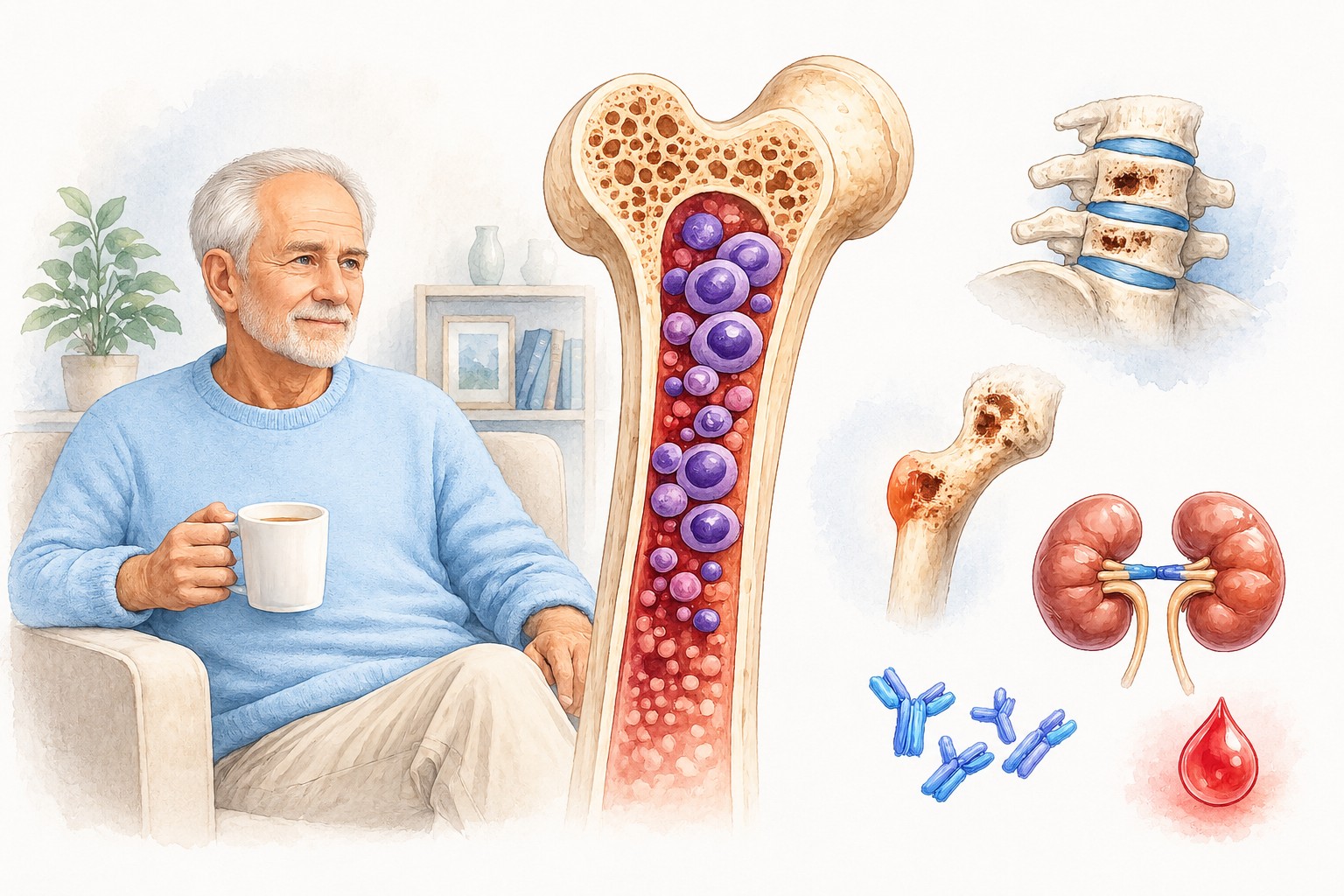
Multiple myeloma is a blood cancer that begins in plasma cells within the bone marrow. Normally, plasma cells are white blood cells that produce antibodies (immunoglobulins) to fight infections. In myeloma, a plasma cell undergoes a mutation and begins multiplying uncontrollably, forming myeloma cells.
Myeloma cells:
- crowd out healthy blood cells in the bone marrow;
- produce large amounts of an identical abnormal protein — M protein (monoclonal protein) — that serves no protective function and accumulates in the body;
- destroy bone tissue, creating lytic lesions;
- can form tumor masses called plasmacytomas.
The disease is called "multiple" myeloma because lesions typically develop simultaneously in more than one bone.
Main Symptoms
- Bone pain (most often in the back)
- Weakness and fatigue
- Frequent infections and fever
- Easy bruising or bleeding
- Thirst and frequent urination (sign of elevated calcium in the blood)
Some patients have no symptoms; the disease may be found incidentally during routine blood tests.
Diagnostic Workup
A full set of tests is required for diagnosis and treatment planning:
Blood tests. Complete blood count (CBC) with differential; comprehensive metabolic panel; immunoglobulin levels (IgG, IgA, IgM, occasionally IgD and IgE); serum protein electrophoresis (SPEP); serum immunofixation electrophoresis (SIFE) to identify M protein type; free light chain assay (kappa/lambda ratio).
Urine tests. 24-hour urine collection for total protein; urine protein electrophoresis (UPEP) and urine immunofixation electrophoresis (UIFE) — to detect M protein and light chains, especially important for assessing kidney damage risk.
Bone marrow biopsy. Aspiration and core biopsy (usually from the iliac crest). Myeloma diagnosis is confirmed when at least 10% of bone marrow cells are abnormal plasma cells.
Cytogenetics and molecular testing. FISH testing for chromosomal abnormalities. High-risk features include: del(17p), t(4;14), t(14;16), t(14;20), amp(1q21)/del(1p), MYC gene rearrangements, TP53 mutations, high beta-2-microglobulin. Two or more of these abnormalities = very high risk.
Imaging. Whole-body PET/CT (preferred, using FDG radiotracer), whole-body low-dose CT, or MRI — to assess bone lesions. Whole-body X-ray (bone survey) is used only when other modalities are unavailable.
Disease Types
- Active (symptomatic) myeloma — requires treatment.
- Solitary plasmacytoma — a single tumor mass in bone or soft tissue; treated locally with radiation therapy ± surgery.
- Smoldering (asymptomatic) myeloma — no symptoms or organ damage; usually observation only, but high-risk patients may need earlier treatment or enrollment in a clinical trial.
Treatment
Treatment of active myeloma combines several approaches given simultaneously: multi-drug therapy, bone-modifying therapy, and supportive care.
First-line multi-drug (quadruplet) therapy typically includes 4 drugs from different classes:
- proteasome inhibitor (bortezomib, carfilzomib, ixazomib);
- immunomodulator (lenalidomide, pomalidomide, thalidomide);
- monoclonal antibody (daratumumab, isatuximab, elotuzumab);
- corticosteroid (dexamethasone).
Preferred first-line combinations: daratumumab + bortezomib + lenalidomide + dexamethasone (Dara-VRd), or isatuximab + bortezomib + lenalidomide + dexamethasone (Isa-VRd). Patients in poor condition may start with a 2- or 3-drug regimen and escalate as they improve.
Autologous hematopoietic cell transplant (auto-HCT). Performed after 4–6 induction cycles in eligible patients. Involves stem cell collection, high-dose chemotherapy, and stem cell reinfusion. Maintenance therapy — preferably lenalidomide — is recommended after transplant. Alternative maintenance: carfilzomib + lenalidomide, or daratumumab + lenalidomide.
Continuing therapy (for transplant-ineligible patients): continue primary treatment or maintenance depending on the situation.
Treatment at relapse or progression. Options include: a new drug combination not previously used; clinical trial; second auto-HCT (if first response lasted ≥ 2 years); CAR T-cell therapy (ciltacabtagene autoleucel / Carvykti; idecabtagene vicleucel / Abecma); bispecific antibodies (teclistamab / Tecvayli, talquetamab / Talvey, elranatamab / Elrexfio, linvoseltamab / Lynozyfic); antibody-drug conjugate (belantamab mafodotin / Blenrep); small molecule inhibitor (venetoclax, preferred in t(11;14)); nuclear export inhibitor (selinexor / Xpovio).
Supportive Care — As Important as Treatment Itself
- Bone protection. Bisphosphonates (zoledronic acid, pamidronate) or denosumab — for all patients receiving primary treatment, for approximately 2 years. Dental evaluation is mandatory before starting — risk of osteonecrosis of the jaw is significant. Vertebroplasty or kyphoplasty may be used for severe vertebral compression fractures.
- Kidney protection. Adequate hydration; control of calcium levels; avoid NSAIDs (ibuprofen, naproxen) and IV contrast agents. Plasmapheresis for hyperviscosity syndrome.
- Infection prevention. Vaccination against pneumococcus, influenza, and COVID-19. Antiviral prophylaxis against herpes zoster (acyclovir/valacyclovir) during therapy with bortezomib, carfilzomib, ixazomib, or daratumumab.
- Thrombosis prevention. Risk of venous thromboembolism is highest in the first 6 months after diagnosis and during immunomodulator-based therapy. Aspirin or anticoagulants are prescribed based on individual risk.
- Anemia treatment. Erythropoiesis-stimulating agents when indicated, with mandatory monitoring for blood clots.
- Fatigue, anxiety, depression. Common problems requiring specialist referral, physical activity, and psychosocial support.
Key Messages for Patients
- Multiple myeloma now has dozens of effective treatment options; for a growing number of patients it is becoming a chronic condition rather than a fatal disease.
- Most patients experience multiple relapses over the course of their lifetime — this is the expected course of the disease, and treatment options remain available at each relapse.
- When possible, treatment should be received at a specialized center with myeloma expertise.
- Active patient participation in decision-making, and open discussion of treatment goals and quality of life with the care team, are essential parts of successful treatment.
- Seeking a second opinion from a myeloma specialist is normal and encouraged.
Source: NCCN Guidelines for Patients® — Multiple Myeloma, 2026 (based on NCCN Clinical Practice Guidelines in Oncology, Version 4.2026 — November 26, 2025). National Comprehensive Cancer Network® (NCCN®).
Full original document available free of charge: NCCN.org/patientguidelines
This material is for informational purposes only and does not replace consultation with a treating physician.
Download PDF
pa_51469664-36f1-43b1-82b0-20eb2259d150_1778331733636.pdf