
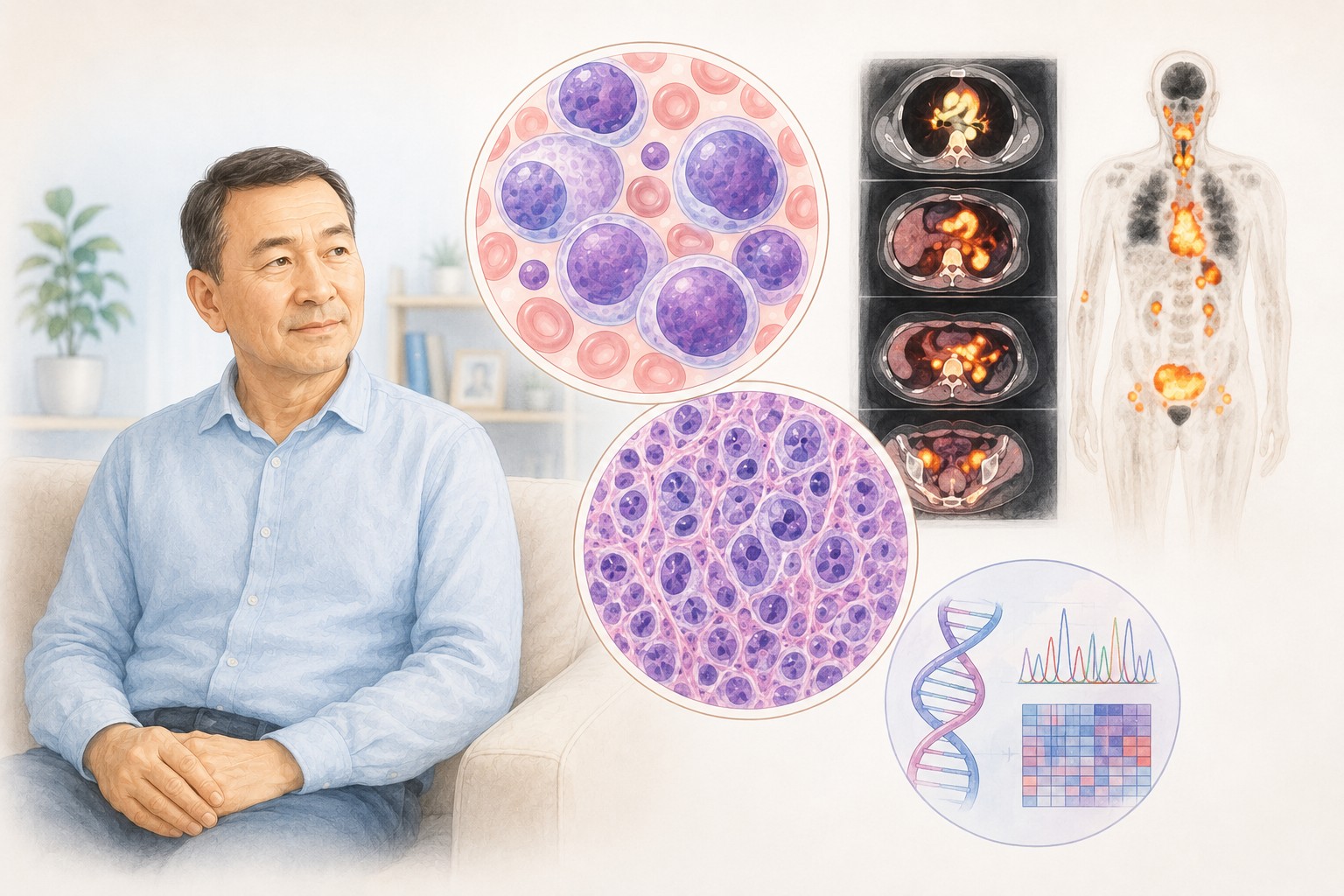
Diffuse Large B-Cell Lymphoma (DLBCL): Key Information for Patients
Based on NCCN Guidelines for Patients® — Diffuse Large B-Cell Lymphomas, 2025 (NCCN Clinical Practice Guidelines in Oncology, B-Cell Lymphomas Version 2.2025 — February 10, 2025)
What Is DLBCL
Diffuse large B-cell lymphoma (DLBCL) is the most common type of non-Hodgkin lymphoma (NHL). It develops from B lymphocytes — a type of white blood cell — which grow out of control and form tumors. Tumors are commonly found in lymph nodes, spleen, liver, bone marrow, or other tissues and organs anywhere in the body.
DLBCL is a fast-growing (aggressive) cancer, but it is also highly treatable. The goal of treatment is cure.
There are many subtypes of large B-cell lymphoma. This guide covers the most common — DLBCL, not otherwise specified (DLBCL-NOS) — as well as several related subtypes including primary mediastinal large B-cell lymphoma (PMBL), high-grade B-cell lymphoma (HGBL), ALK-positive LBCL, mediastinal gray zone lymphoma (MGZL), and primary cutaneous DLBCL, leg type.
Symptoms
- Painless enlargement of lymph nodes (neck, axilla, groin)
- B symptoms: fever without infection, drenching night sweats, unexplained weight loss >10% over 6 months
- Fatigue and weakness
- Abdominal fullness (enlarged spleen or liver)
- Shortness of breath or cough (if mediastinum is involved)
- Symptoms related to the site of extranodal involvement (depending on which organ is affected)
Diagnostic Workup
Biopsy is the cornerstone of diagnosis. Excisional or incisional lymph node biopsy is preferred over needle biopsy when possible. All samples must be reviewed by a pathologist with expertise in lymphoma (hematopathologist).
Essential pathology panel:
- Immunohistochemistry (IHC): CD3, CD20, CD10, CD21, BCL2, BCL6, IRF4/MUM1, MYC ± flow cytometry
- FISH for MYC rearrangement (required for all DLBCL); if MYC+, also FISH for BCL2 and BCL6 rearrangements
- Karyotype
The molecular subtype — germinal center B-cell (GCB) vs. non-GCB — is established by immunophenotyping and is important for prognosis and emerging treatment decisions.
Standard staging workup:
- CBC with differential
- Comprehensive metabolic panel (CMP), LDH, uric acid
- Hepatitis B and C testing (HBV reactivation risk with rituximab)
- HIV testing (recommended for all new lymphoma diagnoses)
- PET/CT scan of the whole body (preferred over CT alone) — gold standard for staging and treatment response assessment
- Cardiac evaluation: ECG + echocardiogram — required before anthracycline-based therapy (doxorubicin)
- Calculation of the International Prognostic Index (IPI): based on age, ECOG performance status, LDH level, stage, and number of extranodal sites
- Pregnancy test if chemotherapy or radiation planned
Additional tests when indicated:
- Lumbar puncture (LP) ± intrathecal (IT) chemotherapy — for CNS staging in high-risk patients: elevated LDH + >1 extranodal site; involvement of testis, kidney, adrenal gland, breast, bone marrow, or CNS; HGBL
- Bone marrow biopsy ± aspirate — in selected cases
- Head/neck CT or MRI with contrast
- Beta-2-microglobulin; hepatitis C testing
- Scrotal ultrasound (DLBCL can involve the testes)
Staging
DLBCL is staged with PET/CT (Ann Arbor system, modified Lugano classification):
- Stage 1: disease in 1 lymph node region or 1 extranodal site
- Stage 2: disease in ≥2 lymph node regions on the same side of the diaphragm
- Stage 2 bulky: stage 1–2 with a mass ≥7.5 cm
- Stage 3: lymph nodes above and below the diaphragm, or above diaphragm + spleen
- Stage 4: spread to extralymphatic organs (bone marrow, liver, lungs, etc.)
Stages 1–2 = limited; stages 3–4 = advanced.
First-Line Treatment
The backbone of DLBCL treatment is chemoimmunotherapy: chemotherapy combined with the anti-CD20 monoclonal antibody rituximab.
Preferred first-line regimens:
- R-CHOP (rituximab + cyclophosphamide + doxorubicin + vincristine + prednisone) — the global standard for DLBCL
- Pola-R-CHP (polatuzumab vedotin + rituximab + cyclophosphamide + doxorubicin + prednisone) — preferred alternative, particularly for advanced stages
Other recommended:
- DA-EPOCH-R (dose-adjusted etoposide + prednisone + vincristine + cyclophosphamide + doxorubicin + rituximab) — used for certain DLBCL subtypes and HIV-associated disease
For patients with cardiac disease (doxorubicin contraindicated): RCDOP, RCEOP, RGCVP, RCEPP, DA-EPOCH-R
For frail patients or age >80: R-mini-CHOP, RCDOP, RGCVP, RCEPP
FDA-approved rituximab biosimilars (Riabni, Ruxience, Truxima, Hycela) may be substituted.
Treatment plan by stage:
| Stage | Regimen | Cycles |
|---|---|---|
| Stages 1–2, non-bulky | R-CHOP | 3 → restage → +1 cycle (total 4) or ISRT |
| Stages 1–2, bulky (≥7.5 cm) | R-CHOP | 6 ± ISRT |
| Stages 3–4 | R-CHOP or Pola-R-CHP | 6 |
Involved-site radiation therapy (ISRT) may be added to treat specific areas of disease.
Response assessment: PET/CT is performed mid-treatment (after 3–4 cycles) and after completing all cycles. Responses: complete response (CR), partial response (PR), stable disease, progressive disease.
Surveillance after remission: physical exam, history, and blood tests every 3–6 months for 5 years, then annually. CT chest/abdomen/pelvis every 6 months for 2 years may be considered.
Relapsed and Refractory Disease
Refractory DLBCL: disease that does not respond to initial therapy. Relapsed DLBCL: disease that returns after a period of remission.
Treatment strategy depends on the time elapsed since last therapy and whether the patient is a candidate for transplant or CAR T-cell therapy.
Relapse <12 months after first-line therapy (early relapse / refractory):
- CD19-directed CAR T-cell therapy — preferred when feasible:
- Axicabtagene ciloleucel (Yescarta)
- Lisocabtagene maraleucel (Breyanzi)
- Tisagenlecleucel (Kymriah)
- Bridging therapy while waiting for CAR T: DHA-platinum salts, GDP, GemOx, ICE, polatuzumab vedotin ± rituximab ± bendamustine, ISRT
- Clinical trial
Relapse >12 months after first-line therapy (late relapse):
- If autologous HCT is planned: salvage platinum-based chemoimmunotherapy (DHA-platinum, GDP, ICE, ESHAP, GemOx, MINE ± rituximab) → autologous HCT if CR is achieved; CAR T-cell therapy or allogeneic HCT if only PR
- If HCT not planned: second-line therapy (see below), palliative ISRT, or best supportive care
Preferred second-line regimens (non-transplant or CAR T setting):
- Epcoritamab-bysp (Epkinly) + GemOx
- Glofitamab-gxbm (Columvi) + GemOx
- Polatuzumab vedotin ± bendamustine ± rituximab
- Polatuzumab vedotin + mosunetuzumab-axgb (Lunsumio)
- Tafasitamab-cxix (Monjuvi) + lenalidomide
Third-line and beyond (≥2 prior lines):
- CAR T-cell therapy (if not previously given) — preferred
- Bispecific antibodies (epcoritamab, glofitamab) — including after HCT or CAR T-cell therapy
- Loncastuximab tesirine-lpyl (Zynlonta)
- Selinexor (Xpovio)
- Brentuximab vedotin + lenalidomide + rituximab (for CD30+ disease)
- Allogeneic HCT — for selected patients achieving second remission
Specific DLBCL Subtypes
Primary Mediastinal Large B-Cell Lymphoma (PMBL) Arises in the mediastinum (behind the breastbone), most common in women aged 30–40. May cause cough, dyspnea, neck/facial swelling (superior vena cava syndrome). Expert hematopathology review essential. Preferred treatment: 6 cycles of DA-EPOCH-R (no radiation needed after complete response) or R-CHOP ± ISRT. For relapse/refractory: pembrolizumab, nivolumab ± brentuximab vedotin, CAR T-cell therapy, HCT.
High-Grade B-Cell Lymphoma (HGBL) — "double-hit" and "triple-hit" Very aggressive lymphomas with simultaneous MYC + BCL2 and/or BCL6 rearrangements. Characterized by high LDH, frequent bone marrow and CNS involvement, high IPI score. CNS prophylaxis (LP + IT chemotherapy) is typically required. R-CHOP is generally insufficient — intensive regimens (DA-EPOCH-R, R-HyperCVAD, R-CODOX-M/R-IVAC) or clinical trial preferred.
ALK-Positive Large B-Cell Lymphoma (ALK+ LBCL) Rare, caused by ALK gene mutation; CD20-negative — rituximab is not used. Clinical trial strongly recommended. First-line: DA-EPOCH, CHOEP, CHOP, HyperCVAD, CODOX-M/IVAC ± ISRT. Relapse/refractory: second-generation ALK inhibitors (alectinib, lorlatinib) followed by allogeneic HCT.
Mediastinal Gray Zone Lymphoma (MGZL) Overlapping features of PMBL and classical Hodgkin lymphoma. Most common in men aged 20–40. Expert hematopathology review essential. If CD20+, rituximab is added. Treatment: R-CHOP or Pola-R-CHP ± ISRT (preferred); DA-EPOCH-R (other recommended). Best managed at centers with experience in this rare subtype.
Primary Cutaneous DLBCL, Leg Type (PC-DLBCL, leg type) Despite the name, can occur anywhere on the skin (torso, arms, back, buttocks). Presents as red/bluish-red skin tumors — it is not skin cancer. Treatment by disease extent:
- Solitary/regional (1 region): RCHOP + ISRT, or ISRT alone, or clinical trial
- Generalized skin-only (≥2 non-adjacent regions): RCHOP ± ISRT, clinical trial
- Extracutaneous (lymph nodes, blood, organs): treat as systemic DLBCL per stage
Supportive Care and Key Side Effects
Tumor lysis syndrome (TLS): rapid cell death during chemotherapy releases toxic metabolites into the bloodstream, causing kidney damage and dangerous electrolyte imbalances. Prevention: adequate hydration, allopurinol or rasburicase, close monitoring of electrolytes and kidney function — especially in high-tumor-burden DLBCL.
Febrile neutropenia: fever in the setting of low neutrophil count is a medical emergency requiring immediate IV antibiotics. Report fever promptly.
Cytokine release syndrome (CRS): may occur with bispecific antibodies and CAR T-cell therapy; symptoms include fever, low blood pressure, difficulty breathing. Managed by the care team.
Hepatitis B reactivation: all patients must be screened before rituximab-based therapy. Prophylactic entecavir is required for HBsAg-positive or anti-HBc-positive patients; continued for 12 months after completion of therapy.
Cardiotoxicity: doxorubicin can cause heart muscle damage (cardiomyopathy). Baseline echocardiogram is mandatory; cardiac function is monitored throughout treatment.
Peripheral neuropathy: vincristine commonly causes numbness, tingling, or weakness, usually starting in the hands and feet. Report symptoms promptly — dose modification may be needed.
Hair loss (alopecia): common with R-CHOP; typically temporary, with regrowth beginning 3–6 months after treatment ends.
Fertility: chemotherapy may permanently impair fertility. Fertility preservation (sperm banking, egg or embryo cryopreservation) should be discussed before starting treatment and referral to a specialist arranged.
CNS prophylaxis: high-risk patients receive intrathecal (IT) methotrexate or cytarabine injected into spinal fluid at the time of lumbar puncture to prevent lymphoma from spreading to the brain or spinal cord.
Drug interactions: turmeric/curcumin, ginkgo biloba, green tea extract, St. John's Wort, antioxidants, antacids, and certain heart or blood pressure medications may interfere with treatment. Always inform the care team about all medications and supplements.
Late effects: secondary cancers, cardiovascular disease, cognitive effects, and other long-term complications from treatment can occur months or years later. Regular follow-up is important.
Key Messages for Patients
- DLBCL is aggressive but highly treatable and curable — even in advanced stages, a significant proportion of patients achieve durable long-term remission.
- Accurate subtype diagnosis — including MYC, BCL2, BCL6 FISH testing and molecular profiling — is critical because it directly determines treatment intensity and choice of regimen.
- R-CHOP or Pola-R-CHP delivered on schedule, without unnecessary dose reductions, gives the best chance of cure. Never skip treatment cycles without discussing with your doctor.
- PET/CT mid-treatment and after completing therapy are essential checkpoints to confirm remission and guide next steps.
- If disease relapses or is refractory, effective salvage options — including CAR T-cell therapy and bispecific antibodies — are available. Ask your oncologist about eligibility early, since these treatments require preparation time.
- Treatment at a center with expertise in aggressive lymphomas and access to CAR T-cell therapy significantly improves outcomes.
- Report any new symptoms — fever, night sweats, new lumps — promptly during follow-up. Early detection of relapse allows more options.
Source: NCCN Guidelines for Patients® — Diffuse Large B-Cell Lymphomas, 2025 (based on NCCN Clinical Practice Guidelines in Oncology, B-Cell Lymphomas Version 2.2025 — February 10, 2025). National Comprehensive Cancer Network® (NCCN®).
Full original document available free of charge: NCCN.org/patientguidelines
This material is for informational purposes only and does not replace consultation with a treating physician.
Download PDF
pa_2fa1efbc-8d06-4da4-a7d0-1e6455441041_1778336541467.pdf